AI Search Trends → Content Strategy – How to Turn Trends into Briefs, Clusters, and a Publishing Cadence
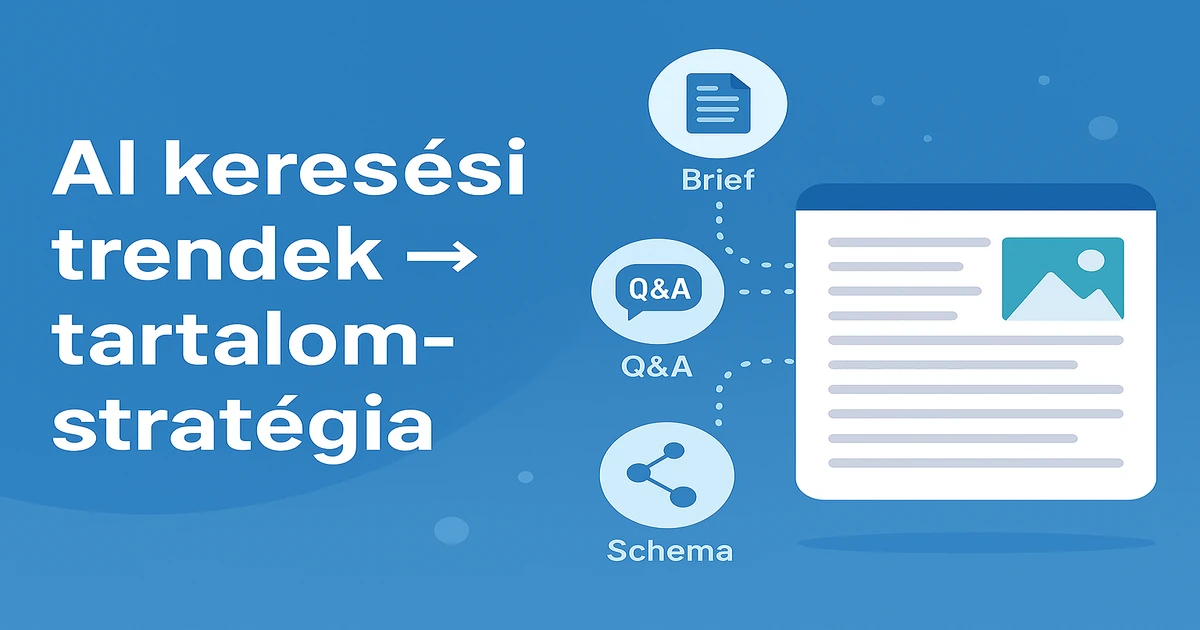
Generative SERPs (e.g., Google SGE ) and the world of answer engines are changing fast. The goal today is no longer just the click, but being cited. In this guide, we’ll show you how to translate AI search trends into concrete briefs, topic clusters, and a publishing cadence—so your content shows up in AI-generated answers.
1) Trend monitoring – what should you watch?
-
Question formats and long-tail: AI thinks in questions. Run AI keyword research specifically for questions, and build a long-tail map (who? where? how? how long?).
-
Zero-click scenarios: when does AI provide a complete answer? In these cases, the goal is citeability and brand visibility .
-
Multimodal visibility: image/video/audio also matter—see multimodal search .
-
Entities and relationships: AI interprets relationships between concepts, people, and places—supported by schema markup and GEO .
2) Brief creation – turning trends into writing tasks
A good brief is short, clear, and AEO-friendly. It includes the goal, the question format, the primary entities, the required outputs, and the markup.
{# Content brief – example Goal: get cited in AI answers for the query "what is multimodal search?" Question format: "What is ...?", "How does ...?" Primary entities: multimodal search, SGE, ChatGPT, image, video, audio Outputs: Q&A block (3–4 questions), HowTo steps, related links Schema: BlogPosting + FAQPage + (if relevant) HowTo, VideoObject Internal links: /blog/multimodalis-kereses, /blog/schema-markup, /blog/ai-tartalom-atalakitas OG image: 1200×630, Hungarian title } ## 3) Topic clusters – hub & spoke structure A cluster consists of a hub page and supporting spoke articles. The hub summarizes the topic and includes a Q&A block; the spokes go deep on the details.
-
Hub: AI SEO fundamentals – What is AI SEO? + What is AEO?
-
Spoke: schema markup , AEO audit , multimodal search , E-E-A-T signals , local AI SEO .
4) Scheduling – cadence and refresh cycle
-
2–3 posts per week within a cluster (hub → spoke → spoke).
-
Monthly refresh: update examples, dates, expand FAQs ( content repurposing ).
-
SGE log: manual checks, change monitoring and zero-click strategy .
5) Must-have markup and UX elements
-
Q&A / HowTo blocks in every article (AEO).
-
Schema: BlogPosting + FAQPage (+ where needed: HowTo, VideoObject, Product).
-
OG images at 1200×630 with a Hungarian title (consistent branding). If you mess this up, here’s the fix list: 12 common AI SEO mistakes .
-
Internal linking hub ↔ spoke (anchors built around question formats).
Summary
AI search trends are only the first step. The key to winning is breaking them down into briefs, organizing them into clusters, and publishing consistently with answerable content. That’s how you increase the odds that your brand gets cited in AI answers.
Related articles
Frequently asked questions
How do I translate an AI trend into a specific article?
Create a short brief: goal, question format, primary entities, required Q&A/HowTo blocks, schema markup, OG image, and internal links—then place it into your cluster.
How fast should I publish?
Publish 2–3 articles per week as you move through a cluster, with a monthly refresh cycle (examples, dates, FAQ expansion) and ongoing SGE logging.
What are the must-have AEO elements?
Q&A/HowTo blocks, BlogPosting + FAQPage schema (and HowTo/VideoObject if needed), consistent OG images, and hub ↔ spoke internal linking.
Enjoyed this article?
Don't miss the latest AI SEO strategies. Check out our services!