Anatomy of an AI SEO Workflow: End-to-End Strategy from A to Z with an AI Assistant
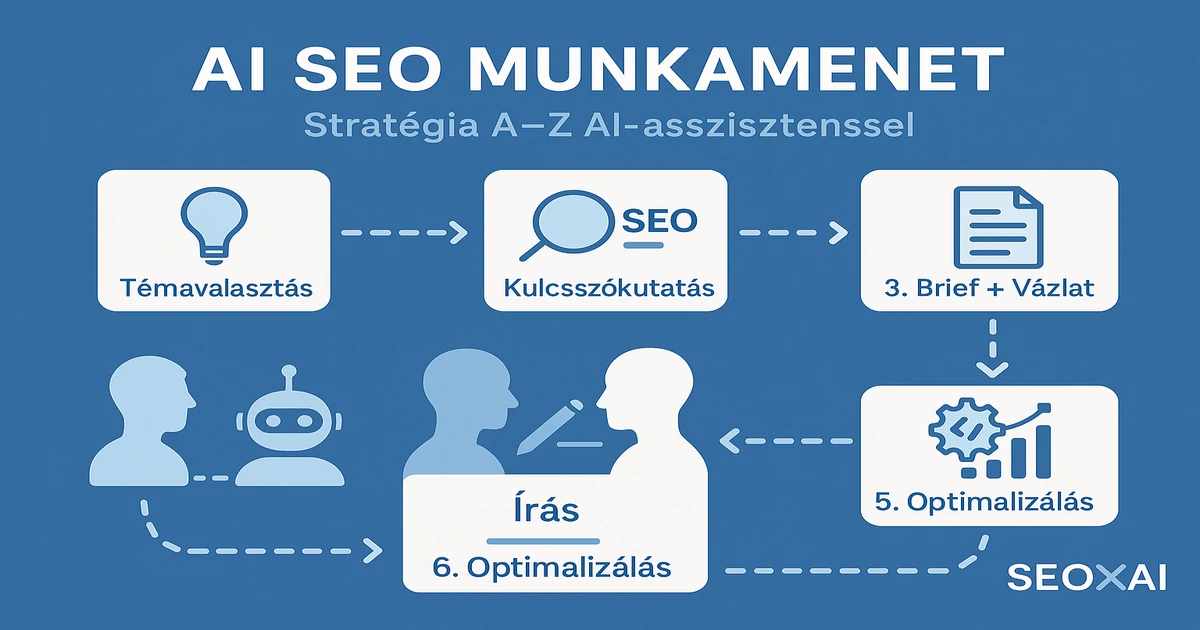
Now that we’ve covered the theory, let’s look at the practice. What does a complete content-strategy workflow look like when you collaborate with an AI assistant? This article walks through a fictional but realistic example step by step—from topic selection to measurement—using specific prompts and tool recommendations, reinforcing the effectiveness of human–machine collaboration.
Step 1: Identify a Topic Area and Brainstorm (Human + AI)
The process always starts with a human, strategic decision. Our goal is to expand the blog of a fictional financial advisory firm.
-
Human Task: Based on business goals, the strategist defines the main direction: “We need to help people in their 30s start investing.”
-
AI Task (Prompt): We use AI for ideation. {
ROLE: You are a financial content strategist. TASK: Collect 10 blog post ideas that are relevant for a beginner investor in their 30s. Topics should be practical and easy to understand. FORMAT: Numbered list.} -
Outcome: From the AI’s list, the strategist chooses the most promising title: “Index funds for beginners.”
Step 2: AI-Powered Keyword Research and Question Collection (AI + Human) For the selected topic, we now map the relevant search intents.
- AI Task (Prompt): Now the AI digs deeper. {
ROLE: You are an SEO expert specialized in AEO. TASK: Collect 20 long-tail questions and important entities for the topic "index funds for beginners." Focus on "what," "how," and "which" types of questions. FORMAT: Two lists: one for questions, one for entities.} - Human Task: The expert reviews the AI-generated list, filters out irrelevant items, and prioritizes based on the most important questions. This step lays the foundation for a RAG-friendly structure. We wrote about keyword research here: AI keyword research .
Step 3: Create a Content Brief and Outline (AI) Based on the collected information, we use AI to generate a detailed brief for the writer.
- AI Task (Prompt): This is a more complex prompt that also uses the outputs of the previous steps. Good prompt engineering is critical here. {
ROLE: You are a lead content strategist. TASK: Create a detailed content brief and an outline consisting of H2–H3 headings. CONTEXT: - Title: Beginner's guide to index funds - Primary questions (from Step 2): [Insert the 10 most important questions here] - Entities (from Step 2): [Insert the 15 most important entities here] - Target audience: Beginner investors in their 30s. FORMAT: Detailed brief in the previously learned format (goal, target audience, entities, questions, recommended schema), then a nested list with the article outline.}
Step 4: Content Writing and Human Value-Add (Human) This is where human expertise is irreplaceable.
-
Human Task: The copywriter writes the article based on the brief. Beyond raw facts, they add their own experience, personal stories, unique analogies, and the brand’s distinct voice. This is the most important part of E-E-A-T, which AI cannot replace.
-
AI Support: The writer can use AI to rewrite a paragraph or run a grammar check, but the substance of the content comes from human knowledge.
Step 5: Optimization and Measurement (AI + Human)
After the finished article is published, the loop closes.
-
AI Task: AI generates the
FAQPageschema, the meta description, and suggests copy for social media posts. -
Human Task: The SEO expert publishes the article, sets up internal links, and then monitors performance using Search Console and other tools—especially the new, AI-focused KPIs .
Frequently Asked Questions
How much time can you save with this workflow?
For an experienced expert, the research and outlining phase can be accelerated by as much as 70–80%. That time can be redirected to creative work and strategic refinement, ultimately resulting in higher-quality content.
What if I don’t have time for Step 4 (human writing)?
Skipping the human value-add is the biggest risk. If AI writes the entire piece, the result will likely be shallow and formulaic. If resources are tight, it’s better to produce fewer—but higher-quality—articles refined by a human.
Can this process be applied to every type of content?
Yes—the principles are universal. It works for a product description, a local service page, or a deep technical article. The key is the right balance between human strategy and AI-powered execution.
Enjoyed this article?
Don't miss the latest AI SEO strategies. Check out our services!