AI SEO and Local Search – How to Show Up in Local AI Answers
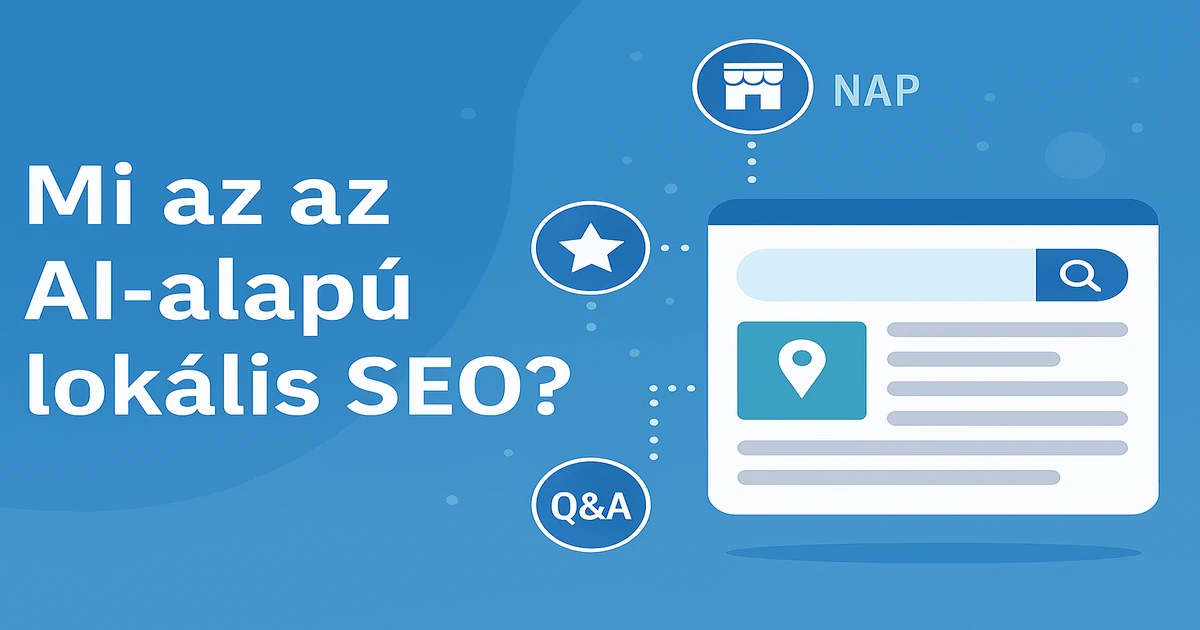
Generative search engines—like Google SGE—are increasingly returning location-based answers: “what’s the best dentist near me?”, “what time is the laptop repair shop in Újbuda open?”. If your business is local, the local layer of AI SEO determines whether you get included in the answer. Let’s walk through the practical steps.
What’s changing in local SEO in the AI era?
Classic local SEO (Name–Address–Phone, links, Google Business Profile) has been joined by entity-based thinking: AI systems look for whether your business is unambiguously identifiable and citable in their answers. Foundational articles: What is AI SEO? , What is AEO? , and GEO – Generative Engine Optimization .
The most important signals AI looks at for local answers
-
Entity consistency (NAP): consistent name, address, and phone everywhere. Common issues and quick fixes: 12 typical AI SEO mistakes .
-
LocalBusiness schema: accurate category, service names, geographic coordinates, opening hours. More details: schema markup guide .
-
Reviews and citability: fresh Google reviews, citable FAQs on service pages. See: how to get into ChatGPT answers .
-
Topical subpages: service × city/neighborhood combinations with well-structured content and Q&A.
-
Multimodal signals: for images, descriptive alt text, location mentions, captions. Details: multimodal search .
Practical implementation – 7 steps
-
Google Business Profile (GBP) fully completed: categories, services, opening hours, photos.
-
LocalBusiness / Organization schema added to the homepage and the main service pages.
-
City/nearby neighborhood pages: e.g., “Dentist in Óbuda” – short intro + FAQ + contact details. Use the content repurposing methods.
-
Q&A and HowTo blocks on every page—AI needs short, citable answers.
-
Review request process: email template, SMS link, thank-you page. Showcase the best ones (aggregateRating).
-
Internal linking in clusters: service → city pages → summary page. Build on AI keyword research .
-
Monitoring: manual SGE tests + Search Console signals. Guide: tracking SGE changes and zero-click strategy .
Sample LocalBusiness JSON-LD (outline)
{{ "@context": "https://schema.org", "@type": "LocalBusiness", "name": "Example Dentistry – Óbuda", "image": "https://www.pelda.hu/foto.jpg", "address": { "@type": "PostalAddress", "streetAddress": "Bécsi út 1.", "addressLocality": "Budapest", "postalCode": "1036", "addressCountry": "HU" }, "geo": { "@type": "GeoCoordinates", "latitude": 47.540, "longitude": 19.037 }, "telephone": "+36 1 123 4567", "openingHoursSpecification": [{ "@type": "OpeningHoursSpecification", "dayOfWeek": ["Monday","Tuesday","Wednesday","Thursday","Friday"], "opens": "09:00", "closes": "18:00" }], "sameAs": ["https://g.co/kgs/valami", "https://facebook.com/peldafogaszat"] }} ## Summary The core of local AI SEO: an identifiable entity + citable answers + consistent signals (schema, NAP, reviews). If you build this consistently, generative engines will naturally find your content and include it in local answers.
Frequently asked questions
What’s the point of AI-driven local SEO?
To make your business clearly identifiable as an entity, and to show up in local AI results (SGE, ChatGPT, Perplexity) with short, citable answers.
Which schema type should I use?
At minimum LocalBusiness (or its more specific subtype) + Organization; on content pages use BlogPosting, FAQPage, and where relevant, Product/Service.
How do I get more citable signals?
Write Q&A and HowTo blocks, request reviews regularly, keep your hours updated, and create service × city landing pages supported by internal linking.
Enjoyed this article?
Don't miss the latest AI SEO strategies. Check out our services!