What Is a Vector Database, and Why Will It Become the New Foundation of GEO?
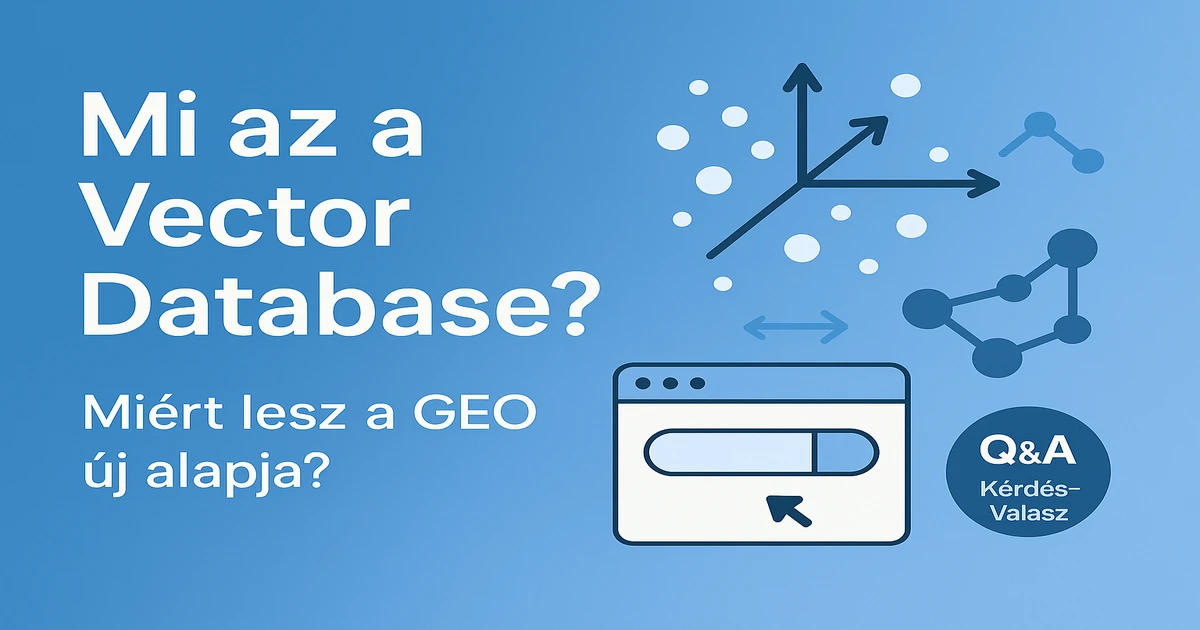
In the era of generative AI, search is shifting from matching keywords to understanding meaning. The engine behind this technological leap is vector search and the vector database. While it sounds complex, the logic is straightforward—and understanding it is essential for the future of SEO: Generative Engine Optimization (GEO).
How does a machine understand meaning? Embeddings, explained simply
Machines don’t understand words—they understand numbers. During vector embedding, a model converts content (text, images, audio) into a hundreds-dimensional sequence of numbers, i.e., a vector.
-
A coordinate in meaning-space: just like every city on a globe has (lat., long.) coordinates, every concept in vector space has a numerical “location.”
-
Closeness = similarity: “dog,” “canine,” “puppy” are close to each other; “dog” and “car” are far apart.
-
Semantic and multimodal search: the AI doesn’t look for the exact word—it looks for points with similar meaning. That’s also why multimodal search works (image ↔ text).
What is a vector database, and why do we need it?
A relational database looks for exact matches ( WHERE user="John"); a vector database looks for similarity. Its job is to store millions/billions of vectors and lightning-fast retrieve the ones closest to the query vector.
-
Storage: we turn content into embeddings and store the vectors.
-
Querying: the user’s question also becomes a vector.
-
Similarity search: the DB finds the closest content vectors.
-
Generation (RAG): the answer is assembled from the most relevant snippets. A great answer starts with a great content brief; more on this here: AI search trends and content strategy .
Why will this become the new foundation of GEO and AEO?
The future of SEO is written not only for users, but also for embedding models: the goal is to get your content’s vector into the right place in semantic space.
-
Clarity & entities: clear definitions and entity-rich writing reduce ambiguity → more accurate embeddings.
-
Structured data: schema markup → better context → better embeddings. This is a stable foundation for Answer Engine Optimization (AEO).
-
E-E-A-T signals getting embedded: signals of source credibility (author, citations, evidence) may increasingly carry weight in models—so trustworthy sources gain an advantage.
Frequently asked questions
As an SEO specialist, do I need to run a vector database?
No. Google and other major players use their own vector databases. Your job is to create content that’s unambiguous, helpful, and easy to “pull into” AI-generated answers.
Does this make keyword research unnecessary?
No, but it changes. The focus shifts to topics, entities, and intent. AI-powered keyword research helps with this.
What are some well-known vector databases?
It’s a fast-moving market: Pinecone, Weaviate, Milvus, Chroma—mostly used by developers for RAG-based applications (chatbots, recommenders, knowledge bases).
Enjoyed this article?
Don't miss the latest AI SEO strategies. Check out our services!