MCP: Another Tech Hype Cycle, or the Thing That Finally Gets AI to Actually Work in Your Ecommerce Store?
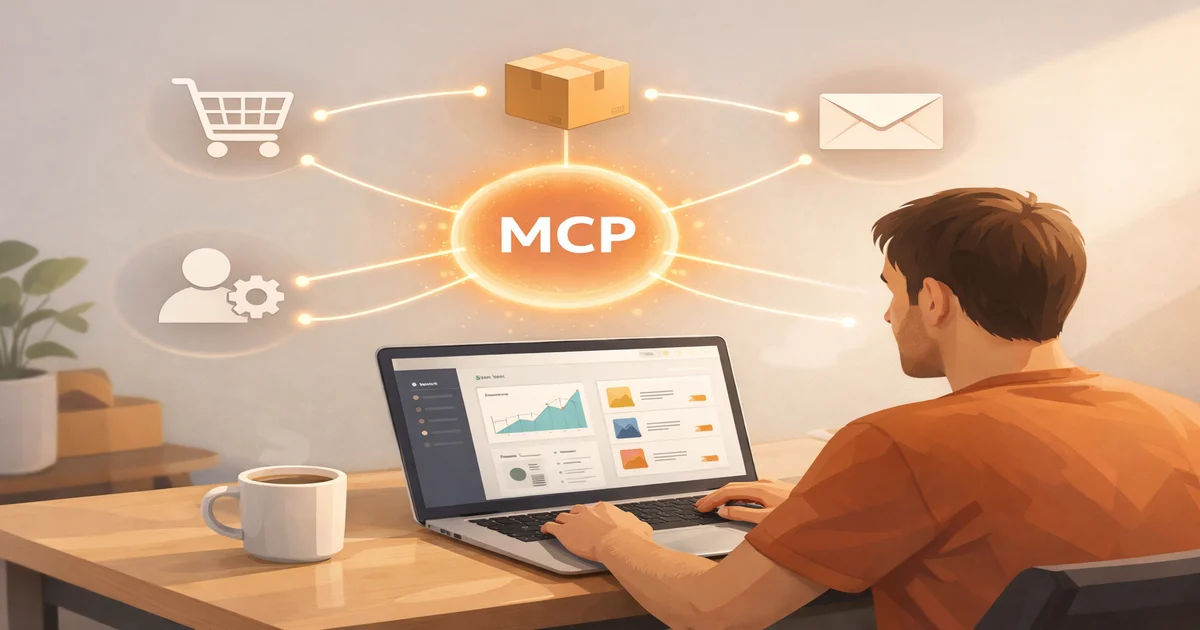
Picture this: it’s Monday morning, coffee in hand, and you open your daily routine: orders, inventory, customer support emails, invoicing, shipping carrier, ads… and somewhere halfway through you get that feeling: “Why isn’t something doing this for me?”
That’s usually when AI shows up. And the chatbot. And automation. Then reality hits: AI is smart, but a lot of the time it can only talk. Your ecommerce store doesn’t need conversation—it needs things to actually happen: order statuses updated, inventory decremented, emails sent, product data improved, reports generated.
MCP shows up right at that “okay, but how do I connect it all?” moment.
What is MCP, in plain English?
MCP (Model Context Protocol) is basically a standardized connector between AI and your business systems.
It’s like USB‑C—just for AI
Back in the day, every phone needed its own charger. Then USB‑C arrived and suddenly it was like, “Okay, I can charge anything with this.”
MCP follows the same logic:
- on one side you have the AI (chatbot, agent, assistant)
- on the other side you have your ecommerce stack (Shopify/WooCommerce, invoicing, warehouse, CRM, shipping carrier, Google Sheets, internal database)
- and you need a consistent way for the AI to ask questions, read data, and in some cases take action inside those systems
What does MCP solve in practice?
Two common painkillers:
- No more one-off, custom “duct-tape” integrations for everything. (Which are expensive and fragile.)
- AI shouldn’t “guess”—it should get real context. Like real inventory, real order data, real shipping info.
A mini story: the “everything is in stock” chatbot
At one store, the chatbot answered nicely—except for one small issue: it couldn’t see warehouse stock. So when someone asked about a product, the bot confidently said, “Yep, it’s available.”
Reality: 0 units.
With an MCP-style connection, the bot doesn’t improvise—it checks the system and says: “We currently have 0 in stock, but 20 are arriving on Friday.”
Summary: MCP isn’t “another AI thing.” It’s a connectivity standard that finally lets AI access your store’s real data and workflows.
What does this have to do with AI? (And why did it become so important by 2026)
In 2026, we’re no longer at the stage where AI just “writes nice sentences.” We’re at the stage where AI is built around agents: systems that can execute tasks in multiple steps.
We wrote about this separately because it truly is a new era: The Age of Autonomous AI Agents: Optimization for Action-Taking AI.
An AI agent is like a coworker who works fast—if you give them the warehouse key
Agentic AI doesn’t stop at answering questions. It does things like:
- checks orders
- spots an issue (e.g., delayed shipment)
- emails the customer
- opens a ticket with the carrier
- updates a spreadsheet
But to do that, it needs access. Secure, controlled access. MCP helps with that: so the AI doesn’t rely on screen scraping and a thousand hacks, but instead works through a standard protocol.
What happens without MCP?
Honestly? What many companies have already lived through:
- every new idea requires a new integration
- every integration is a new failure point
- eventually nobody dares touch anything because “if we mess with this, invoicing breaks”
What’s better with MCP?
- More consistent connectivity to tools
- Easier scaling (connecting a new tool isn’t a mini project)
- Cleaner permissioning and logging is more achievable (this matters because with AI, the “who did what?” question suddenly becomes very real)
If you want the big picture of where AI + automation is in 2026 from a business perspective, read this too: AI and automation: Where are we in 2026, and what turns it into a real business advantage?
Summary: MCP matters now because AI isn’t just talking anymore—it wants to work. And for that you need a standardized, secure “switchboard” into your systems.
Ecommerce examples: where does this show up at checkout?
Okay, but what do you get out of this as an ecommerce store? Let’s look at a few very grounded situations.
Customer support that doesn’t just answer—it actually resolves
The big trick isn’t that AI can write: “We’re sorry for the inconvenience.” It’s that it:
- sees the order status
- sees the tracking
- sees the carrier turned the package back
- and automatically offers a resolution (reshipment, coupon, exchange)
MCP is interesting here because the bot has to touch multiple systems: store admin, carrier, CRM, email.
Cleaning up inventory and product data (the quiet profit)
80% of ecommerce stores struggle with product data:
- missing attributes
- inconsistent naming
- wrong categories
- duplicate products
An AI agent with MCP-style connections doesn’t just generate text—it can:
- collect missing fields
- propose updates
- and if you allow it, write changes back into the system with approval
It’s not flashy, but by the end of the month the math shows up: fewer back-and-forth questions, better findability, fewer messed-up orders.
Agentic commerce: when a human isn’t buying from you
This is the part that sounds a bit sci-fi, but by 2026 it’s very real: the customer’s AI buys. The customer isn’t clicking around—their agent handles it.
And that’s where standardized access on your side becomes more valuable: product data, shipping, returns, compatibility, bundle offers.
If you want concrete examples, here’s a dedicated article: Agentic Commerce: When AI—Not a Human—Buys in Your Ecommerce Store
Summary: for ecommerce, MCP turns into money where AI needs real data from multiple systems—and where it has to take action, not just reply.
Should you care? (Spoiler: not for everyone, not right now)
Here’s the honest part: just because something is cool doesn’t mean it will increase your profit tomorrow.
When is it worth pulling MCP into the conversation?
This starts to get interesting if at least 2–3 of these describe you:
- you have multiple systems, and it already hurts that things are fragmented (store + invoicing + warehouse + CRM + helpdesk)
- you want an AI agent that doesn’t just chat but completes workflows
- you have 5–20 hours/week of “human robot work” (status updates, copy-pasting, reports, emails)
- you’re scaling and you don’t want to hire a new person for every new process
If you’re still at “I’d like some AI but I don’t know where to start,” read this first: AI in business: does it actually make money, or is it just more noise? (And where you should even begin)
When should you not obsess over this?
- If your store is a 1–2 person operation and everything still fits in your head + Excel.
- If you don’t have stable processes (AI doesn’t create order—it amplifies chaos).
- If you don’t even have the basic automations (e.g., abandoned cart, automated invoicing, baseline reporting).
Okay, but what does “implementation” look like in real life?
For many stores, we don’t start with MCP. We start with simpler connections (Zapier/Make/n8n), and only move in a “more serious” direction if:
- it’s truly a critical workflow
- you need reliability, logging, permissions
- you’ll have many integrations
This article helps you decide: Zapier, Make, n8n vs. custom AI automation: which one would you trust with running your company?
Summary: MCP isn’t mandatory homework. You need it when you’re truly putting AI to work and want to connect multiple systems securely and at scale.
Conclusion
MCP is essentially a standard bridge between AI and your ecommerce systems. You won’t succeed because “you have MCP,” but because AI can finally work from real data and complete real tasks end-to-end.
For your next step, do this: list 10 recurring, boring ecommerce tasks that eat your time every week—and see which ones require access to multiple systems. That’s where MCP starts getting interesting.
FAQ
Is MCP a specific piece of software I need to buy?
No. MCP is more of a protocol/standard: a shared “language” that AI tools can use to connect to external systems. In practice, it’s implemented via some tool or a custom development.
How is MCP different from a normal API integration?
An API integration is like manufacturing a separate adapter for every tool. MCP’s goal is a more unified framework that makes AI tool usage and context easier to manage (with permissions and standard call patterns).
Do I need a developer?
If you want to use it seriously and reliably (e.g., order changes, financial workflows), then in most cases yes. But in many situations you can start with no-code/low-code automation and only later move toward MCP/custom solutions.
Is it safe to give AI access to my ecommerce store?
It can be safe, but not automatically. You need permissions (what it can and can’t do), logging, approval checkpoints, and a test environment. The “connect it and see what happens” approach is especially risky here.
What’s the first ecommerce process worth tackling with AI + integrations?
Usually customer support status questions (where’s my package, when will it arrive, can I modify it), because there’s lots of repetition and the time savings are easy to measure. The second typical win is cleaning up product data and automating internal reporting.
Enjoyed this article?
Don't miss the latest AI SEO strategies. Check out our services!